new rock
| njuː rɒk |
noun
Plastic that wind, waves, sun and living creatures have weathered into the form of stone.
A word coined by the artist, 2017 · more than 3,000 collected to date
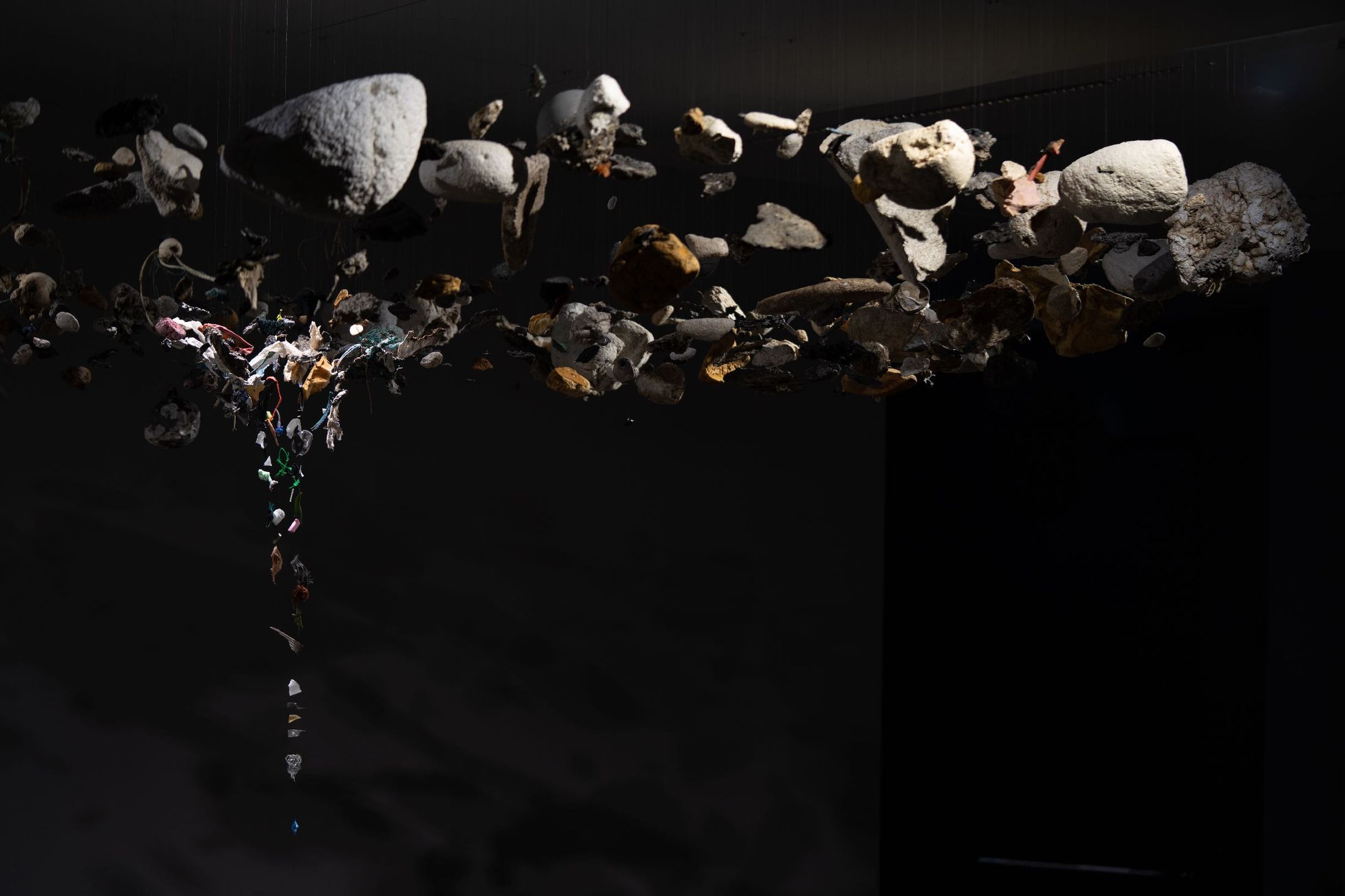
Plastic that wind, waves, sun and living creatures have weathered into the form of stone.
A word coined by the artist, 2017 · more than 3,000 collected to date
Origin
In 2017, on a Korean beach, Chang Hanna bent down to pick up a white, rounded stone. It weighed almost nothing. It was styrofoam — worn by the sea until it had taken the shape of rock.
She has been collecting ever since. Beginning with the waters off Jeju, she has walked the shores and rivers of Incheon, Yangyang, Goseong, Uljin, Pohang, Busan, Sinan, Gochang and Seoul, gathering more than three thousand of these objects. She named them New Rock: a word for a material that had arrived before anyone had thought to describe it.
Her practice is part fieldwork, part natural history, part drawing. Each specimen is recorded with the date and the place it was found — not as documentation, but as an insistence. Not somewhere, someday. Here, now.
Collection sites, 2017—present
Two conditions must hold. It has to be plastic — a molecular structure designed by people, which nature cannot break down. And it has to have spent long enough in the open to be changed by it.
Physical weathering rounds and pits the surface. It happens fastest in the soft, air-filled plastics: expanded polystyrene, expanded polyurethane.
Sun, or a fire someone lit on the shore. The plastic slumps, flows and cools, and settles into the contours of the stone beside it.
Marine organisms settle on it, insects burrow into it, plants root in it. At that point the plastic stops being debris and starts being ground.
Chapter I
Objects that left the factory identical to the millimetre, and came back from the sea as individuals.
Chang treats each find the way a mineralogist treats a mineral: collected, drawn, measured, labelled with its site and year, and set out for close looking. The classification is deliberate. It is how a thing is admitted into the record of the world.
In the Korean tradition of suseok, a found stone is displayed on a stand and contemplated for its form. Chang gives the same treatment to plastic — and the courtesy is unsettling, because it works.
Photographed against a plain ground, at the scale of a portrait. Nothing is added; the light simply takes them seriously.
Close-range photographs made where the boundary has already failed: barnacles on a buoy, moss in a handle, melt fused to basalt.
A ten-month solo exhibition, 2023—2024. Specimens, drawings, video and collected plastic arranged as a working museum of a material that has no museum yet.
Chapter II
There are so many New Rocks that together they make ground.
Plants send roots into them. Sand and sediment gather around them. They fracture, and the fragments become part of the soil. What began as an object on a beach becomes a layer — and a layer is how the earth keeps its records.
Collected plastic suspended on thread, each piece hung at the height at which it was found rooted. The shadows do most of the work.
An ongoing display of the study itself: pencil drawings, prints, single-channel video, collected plastic and mirrors. It follows one question — how does a New Rock become part of the ground — and refuses to shorten the answer.
Chapter III
We define nature as that to which no human force has been added. Today, is there any nature left that fits the definition?
One day, fine white powder appeared among the specimens in the studio. Chang swept it away for several days before she looked properly. Ants had moved into a piece of styrofoam collected from the Incheon coast, and were carrying out the grains as they dug. The mound on the floor was the excavated wall of their nest.
She calls what follows New Nature: not a ruined nature, and not an artificial one, but an ecology that has absorbed our by-products and carried on. It makes no hierarchy and no exception. It accepts even our contamination.
“Artifacts that come out of the factory without an error of a single millimetre or gram now have their own unique appearance in nature. Just like everything in nature.” Chang Hanna, artist's note
Field-guide plates for creatures that already exist: the sparrow, the ant in the styrofoam, the tree frog at Chernobyl. Drawn in the register of nineteenth-century natural history, and dated to now.
The work has two axes. The vertical column of plastic is accumulation — capital stacking upward, and the human habit of dividing above from below into a hierarchy. The horizontal field of New Rock is what happens when the same material spends time outdoors: the line between made and grown dissolves, and it becomes part of nature.
Collecting has taught her that people sort and nature does not. Nature draws no boundary, assigns no rank, and takes the artificial in as its own. She wanted the horizontal spread to carry that — the vitality of a world that keeps absorbing even what harms it.
From the artist's interview for Young Korean Artists 2025
Chapter IV
In 1970, Robert Smithson moved black basalt into a salt lake with earthmovers. In 2024, Chang tied New Rocks together by hand with fishing line and let the water hold them.
At Cheongchoho — a brackish lagoon in Sokcho where fresh water meets the sea — she worked with local surfers to lay out a spiral 15 by 42 metres across. Nothing was excavated and no terrain was altered. The material was already there. For the length of the exhibition the rocks lived with the lagoon's ecosystem and went on weathering.
She has made these interventions on the summit of Inwangsan in Seoul and in the grounds of the Daegu Art Museum. The prefix new is not a claim of innovation. It marks a change in what we are able to notice.
Writing
Selected observations from curators and critics who have written on the New Rock project, 2023—2025. Paraphrased in English; full texts available on request.
Reads the work as a moving map of plastic's transversal life — a common material travelling through nature and back into the bodies and timescales of human and non-human beings alike.
Places the New Rock beside the found object of art history: an item the artist did not make, but chose, classified and granted the status of art — conceptual work carried out by a practitioner who also acts.
Argues that New Land Art cuts across the spectacle of 1970s Land Art: instead of reshaping terrain, it reassembles traces that are already present, and makes the Anthropocene something we sense rather than something we are told.
Locates the project within new materialism, where the interesting question is not the discovery of a new substance but the demand that we reclassify — and accept — the relation between ourselves and nature.
Writes that nature has escaped the fixed category we kept it in. What stands in its place is neither anti-nature nor the absence of nature, but a new nature — unfinished, and still simmering.
Notes that Chang finds beauty in a contaminated nature, admiring plastic that left the factory identical and returned from the sea with a form of its own — and asks how far art can travel beyond the human point of view.
Biography
b. Korea. Lives and works in Seoul. BFA in Sculpture, College of Fine Arts, Seoul National University.
Chang works across collecting, drawing, photography, video and installation. Her New Rock project has been shown at the National Museum of Modern and Contemporary Art (MMCA) Gwacheon, the Museum of Contemporary Art Busan, Nam June Paik Art Center, Daegu Art Museum, Clayarch Gimhae Museum of Art, Seoul Museum of Art's Art Archive, the Gwangju Biennale Pavilion and the Gangwon International Triennale, as well as in science museums, botanical gardens and on shorelines. She was in residence at MMCA Goyang in 2023.
She is available for exhibitions, commissions, residencies, collaborations with scientists and educators, and public programmes internationally.